Music that's intentional, not just there.
Arcbeat is a planning tool for yoga teachers. Start from a mapped playlist: every song in class order, with where it breaks and where it comes back. Then take one track and build the way up so the pose, or the burnout, arrives exactly there, before anyone is on a mat. So the class becomes an experience, not a workout with a soundtrack.
Join the beta Open ArcbeatThe arc of a class
One build-up
Playlists
Sculpt playlists, mapped: where every song breaks, on one page.
Seventeen songs in class order, one per block, in their clean versions. For each one, the big one, counted in eights from the beat, and when to wrap; the few to turn up and sync are marked. Every break is checked by ear. Print it: in class, the page is your notes.
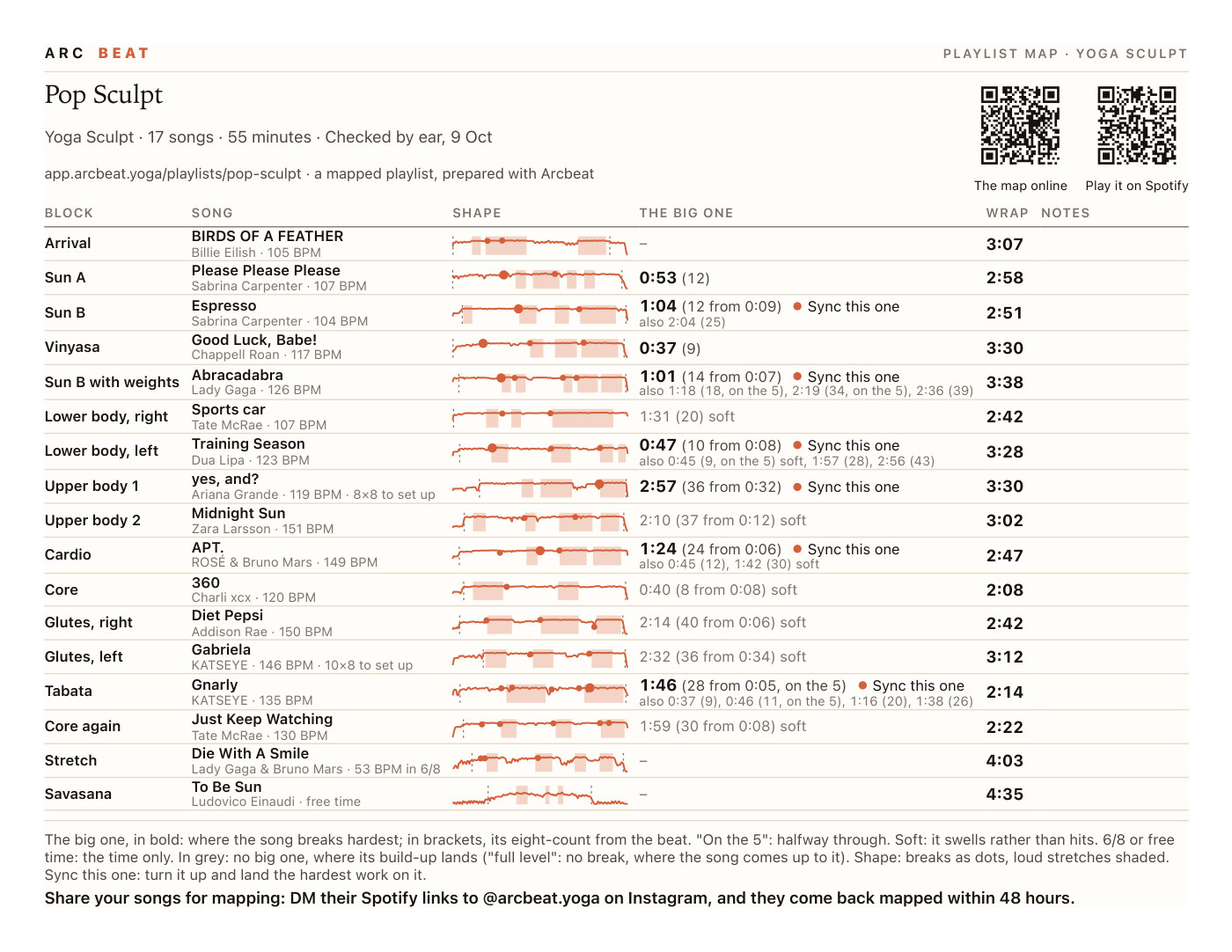
Pop Sculpt
Yoga Sculpt · 17 songs · 55 minutes · checked by ear
- The mapon screen, every song's shape
- The PDFone page, to print
- On Spotifythe clean versions, in class order
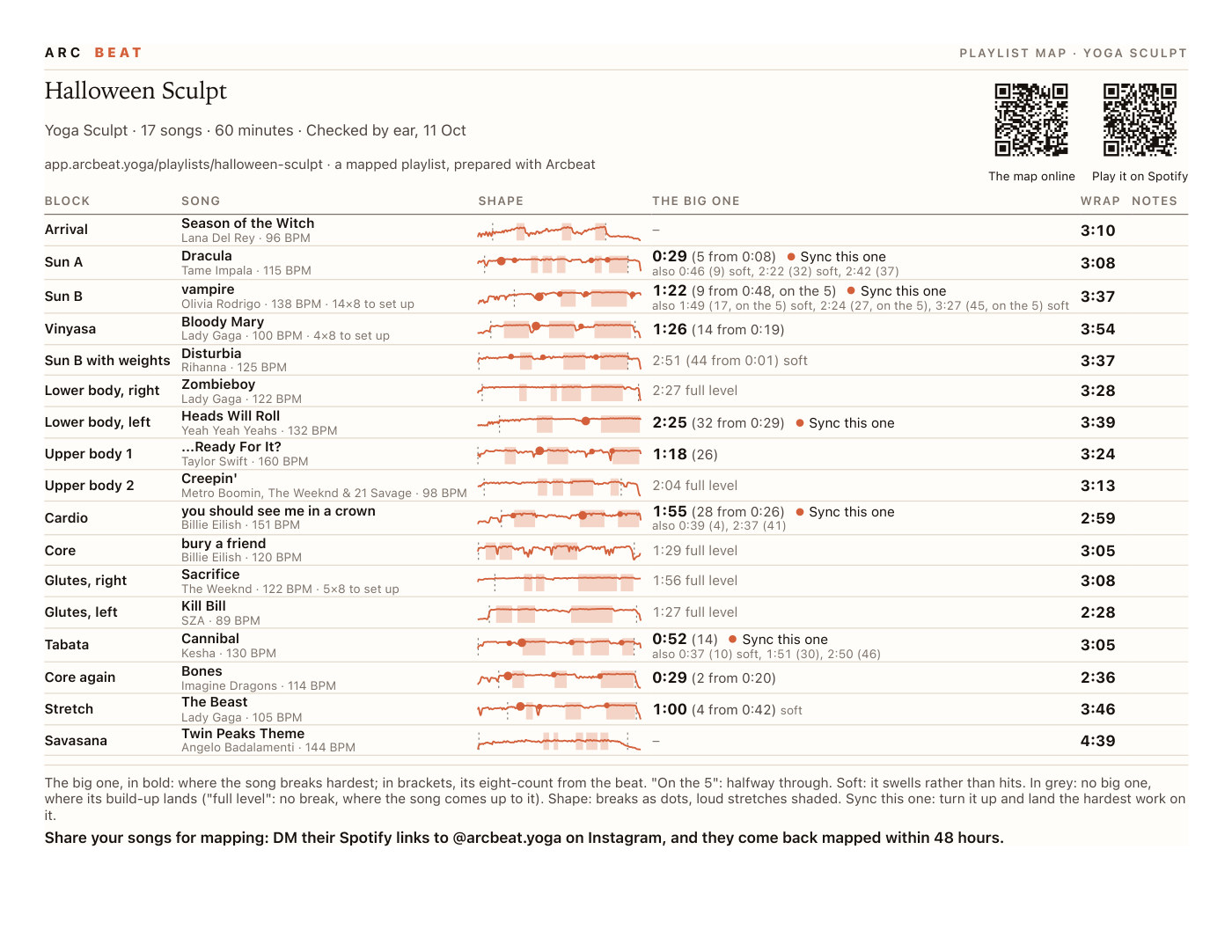
Halloween Sculpt
Yoga Sculpt · 17 songs · 60 minutes · checked by ear
Dark pop and hip-hop for the two weeks before the 31st, nothing novelty, every edit clean.
- The mapon screen, every song's shape
- The PDFone page, to print
- On Spotifythe clean versions, in class order
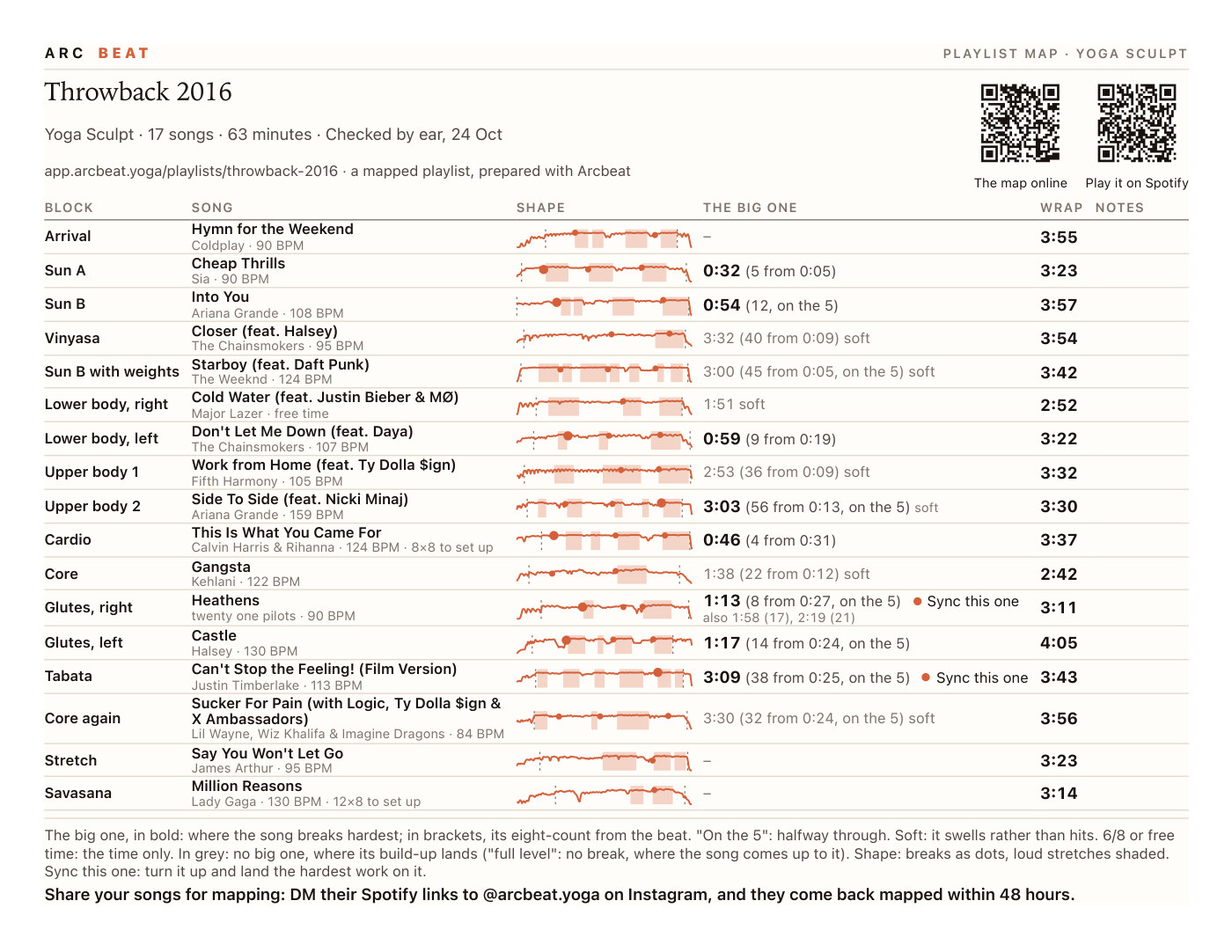
Throwback 2016
Yoga Sculpt · 17 songs · 63 minutes · checked by ear
The hits of 2016, one per block, in the clean edits: mapped in a day for a Halloween class a teacher was building.
- The mapon screen, every song's shape
- The PDFone page, to print
- On Spotifythe clean versions, in class order
Want your own songs mapped? Share them with @arcbeat.yoga on Instagram, and they come back mapped within 48 hours.
The experience
Anyone who practises can tell within ten minutes whether a class will be an experience or a workout with a soundtrack.
In the good ones, the music, the sequence and the cueing are locked together. The peak pose arrives when the music breaks. The cue lands on the phrase change. The refrain comes back and the room goes up with it. You leave feeling different.
In most classes the music is background. It plays. The class happens. The two never meet. Something gentle to open, something gentle for savasana, and one flat middle in between: good music, playing continuously, going nowhere. The music sits at the same level during the hardest pose of the class as it did during cat-cow.
An okay class
A good stretch. You check the clock somewhere in the middle. You leave loose, and forget it by lunch.
An experience
You lose track of time. The hard pose arrives and something carries you into it. You are still thinking about it that evening.
Both had the same poses. The difference was when things landed. When the breath, the cue and the music arrive together, the room stops deciding and starts moving as one; that is the flow state, and repetition is what produces it. The wheel on every return of the refrain. The last round of the vinyasa starting exactly where the track lands. Effort that is carried rather than pushed.
Students don't come back for a sequence. They come back for how a room felt, and they follow the teacher who can do it twice. Arcbeat exists so that a teacher can do it on purpose, and teach it.
Who it's for
Teachers who already plan the sequence, and want the music to know about it.
The flow teacher
You teach vinyasa, power or cardio flow to a playlist you chose with care. Track changes land near section changes. But where each track breaks, nobody placed that. Sometimes one ends inside the peak pose.
The one who lands the wheel
You already have a track whose refrain keeps coming back, and you push up on every return. You do it by ear, after many playthroughs. Arcbeat finds every return and shows the room what you hear.
The sculpt teacher
You teach Yoga Sculpt to a new playlist every few weeks. Arcbeat maps it, where every song breaks, counted in eights from the beat, and marks the few worth turning up. Open one, choose the exercise, squats, lunges, arms, and the sets are written zone by zone, the burnout on the big one.
The trainee
Two hundred hours covers anatomy, alignment, safety. Some covers cueing. Almost none covers the arc. Arcbeat makes the structure visible, so the skill can be learned rather than absorbed over years.
What it does
One build-up: a pose or an exercise, and the way up to it, on one track.
The playlist's map covers the hour; a build-up is one track and one flow, where you sync. A teacher picks a track and says what it lands on: a wheel, a chair, the last round of the vinyasa, or, for a sculpt block, an exercise, its burnout on the big one. Arcbeat lays the way up on the track's zones: recovery where it is quiet, a warrior where the groove comes in, effort where it lands. She adjusts, practises it, teaches it. If it works, she makes another.
- 3:01Where the track lands, and every drop and return before it. The pose you chose arrives there; on the returns it is held again, and the app builds the way down and up between.
- 2 roundsHow much room you have to get there. A round of the vinyasa takes about forty seconds at this tempo; the app counts the landings down to the last one.
- 0:26Where your voice carries furthest. A teacher cues all the way through a build-up; in the quiet beds a cue lands hardest, and the app finds them.
- bridgeThe sequence knows where the body is. A wheel is preceded by a bridge, a chair by a forward fold, a chaturanga by a plank, the way the Sun Salutations do it. If a sequence has to turn onto the back, it says so.
- elasticSlack goes where it is cheap. Drops are windows, not downbeats. The rounds before one stretch or cut; the landing stays.
- yoursThe music stays yours. You play the track, in Spotify or wherever else you already play it, and Arcbeat listens through the microphone and follows. Nothing it hears leaves the browser, and what it keeps is the map of where the music breaks, never the recording. Tracks made for Arcbeat play here and say so. Ask for a track you play and the build-up is built on it.
How you'd use it
Twenty minutes the night before, then close it.
Start from a track. You have the music.
The track you always wanted to teach to, or the one you already use for the wheel. First question: what does it land on? Arcbeat listens to the track and cuts it into zones, the quiet stretches, the groove, the rises, the landings, then lays a sequence on them that lands your pose where the music lands. You change any of it, pose by pose; each zone offers what fits, and says when it is full.
Start from the flow. You have the sequence.
Write it as you would on paper and mark the poses that should land on the music. Arcbeat finds the track in your library whose landings fall where yours are, or generates one to fit, section by section, with a rise into every push.
Say what it lands on
A wheel, a chair, a chaturanga, or the last round of the vinyasa; for a sculpt block, an exercise, its burnout on the big one. Everything before it is the way up.
Lay the way up on the track
Zone by zone from the analysis: where it breaks, where it comes back, where a full cue fits without shouting over a beat. Change the track and the sequence follows.
Practise it once, then teach it
Press play here, then start the track yourself: in Spotify on your phone, with Arcbeat open on a computer, and it picks the music up by ear. The pose you are in shows large, with the next one and the time to the next drop, and the sequence follows the music. Then close the app. Nothing runs on the mat; if the room needs one more round, take it. The landing is still there.
Every build-up you save goes into your library: practise it again, or make another from a track you play. The hour is the playlist's map; the build-up is the part that is hard to get right.
Why
Prepared, not performed.
You already shaped the class. You already chose the playlist. The only question is whether you chose where things fall, or shuffle did. Unexamined structure isn't more mindful. It's unexamined.
The app closes before class starts. No timer, no live view, nothing on the mat. Pause the music, run twenty minutes long, throw the plan out. None of it breaks anything, because the plan was never the thing you were teaching. Deciding in advance is what lets you stop deciding.
And silence is placed, not absent. Cut the track and your voice is the only thing in the room; when the music returns it lands twice as hard for having been gone.
A few teachers are trying it now, on their own music.
There is nothing to sign in to: open Arcbeat, open a playlist's map, and it shows you where every song breaks; open one of its songs and say what it lands on. To practise a build-up, play the track yourself, in Spotify on your phone with Arcbeat on a computer, and it follows the music by ear. The tracks made for Arcbeat play in the browser and need no second screen. Join the beta and you will hear when the music you asked for has been analysed. One email to say you are in, maybe one later asking what you'd want it to do. No newsletter.
Works with